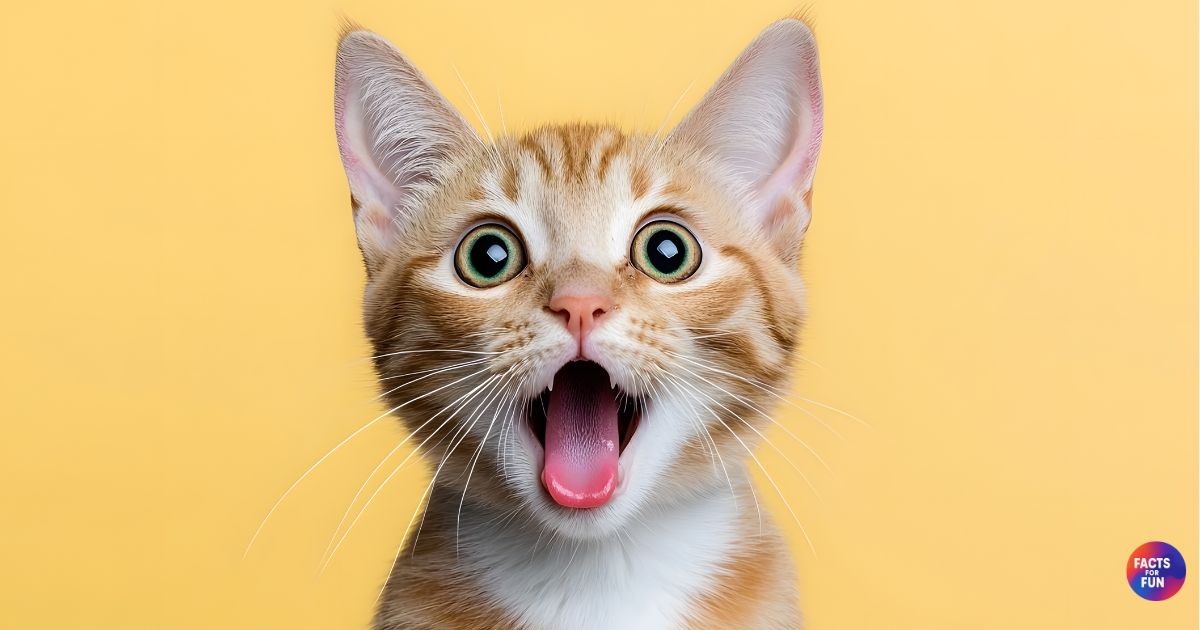
Cats share our homes but still live by the rules of wild hunters. Beneath their calm, silky surface lies a miniature predator, a creature shaped by evolution to survive, adapt, and charm us into serving dinner twice. Here are some of the most surprising, science-based facts about domestic cats that explain why they’re so endlessly fascinating.
- Cats Are 95.6% Tiger
- Their Bodies Are Built for Acrobatics
- Whiskers Work Like Radar
- Cats Walk Like Camels and Giraffes
- They Can Outrun an Olympian
- Purring Is a Built-In Healing Device
- Cats Cannot Taste Sweetness
- Their Eyes Are Engineered for the Night
- Communication Was Re-Engineered for Humans
- Every Cat Nose Is Unique
- Cats Sleep Most of Their Lives
- Ancient People Worshipped Cats for Practical Reasons
- Purring May Heal Humans Too
- The Oldest Known Cat Was Buried 9,500 Years Ago
- The Loudest Purr on Record Hit 67.8 Decibels
- Cats Help Us Stay Healthy
- Cats Once Saved Humans from the Plague — Indirectly
- Cats Are “Super Learners”
- The Maine Coon Is a Gentle Giant
- The World’s Oldest Cat Lived to 38
Cats Are 95.6% Tiger
Genetic research shows that the DNA of a domestic cat matches a tiger’s genome by almost 96 percent. That’s why your sleepy lap cat stretches, stalks toys, and pounces with the same mechanics as its wild cousin. Both species even share similar vocalization patterns and scent-marking behavior — proof that evolution simply shrank a tiger into a sofa-sized version.
Their Bodies Are Built for Acrobatics
A cat’s skeleton contains about 230 bones — more than a human’s — with flexible joints and a floating collarbone that isn’t attached to other bones. This unique design lets them twist mid-air, squeeze through spaces the size of their heads, and walk away unharmed from falls that would injure most animals. Their spines act like springs, storing and releasing energy with each leap.
Whiskers Work Like Radar
Whiskers, or vibrissae, are deeply embedded sensory hairs connected to thousands of nerve endings. They detect air movement and vibration, allowing cats to sense obstacles or prey in near darkness. When a cat pokes its face into a box, those whiskers calculate distance with millimeter accuracy — far better than any built-in motion sensor.
Read more: Cat Whiskers Facts: The Hidden Superpower of Every Feline
Cats Walk Like Camels and Giraffes
Most four-legged animals move their front and back legs alternately, but cats move the right side of their body first, then the left — the same pattern used by camels and giraffes. This unusual gait keeps their steps silent and balanced, an evolutionary trick for sneaking up on prey.
They Can Outrun an Olympian
For short bursts, domestic cats can reach speeds of 30 miles per hour (48 km/h), faster than Usain Bolt’s average sprint. They accelerate like sports cars but burn energy quickly — a perfect adaptation for ambush hunting rather than long chases.
Purring Is a Built-In Healing Device
The soothing hum of a cat’s purr isn’t just for comfort. The vibration frequency, between 25 and 150 Hz, stimulates bone density and muscle repair. Veterinarians note that cats recover from fractures faster than many animals. Humans benefit, too — petting a purring cat lowers blood pressure and anxiety levels.
👉 Learn more in Why Cats Purr: The Science, Emotions, and Healing Power Behind the Sound
Cats Cannot Taste Sweetness
A missing gene means cats lack the receptor for detecting sugar. When they lick ice cream, they enjoy the fat and texture, not the flavor. Their taste buds are tuned for protein and amino acids — a reflection of their pure carnivore diet.
Their Eyes Are Engineered for the Night
Cats see in just one-sixth of the light humans need. Behind their retinas lies a mirror-like membrane called the tapetum lucidum that reflects light back through the photoreceptors, effectively giving vision a second chance. That’s what causes their eyes to glow green or gold in the dark.
Communication Was Re-Engineered for Humans
Adult cats rarely meow to one another; the sound is reserved almost entirely for people. Over thousands of years of domestication, cats developed a “baby-like” meow that triggers a human’s nurturing response. In essence, your cat is fluent in emotional manipulation.
Every Cat Nose Is Unique
If you look closely, the pattern of ridges and bumps on a cat’s nose is as distinctive as a human fingerprint. Some animal shelters now use high-resolution nose scans for identification — a future replacement for ID chips.
Cats Sleep Most of Their Lives
On average, cats sleep 12–16 hours per day — about 70 percent of their lifetime. But they’re not lazy: sleep conserves energy for short, explosive activity. Even in deep rest, their brains remain alert to sounds like opening a food can.
Ancient People Worshipped Cats for Practical Reasons
In ancient Egypt, cats were sacred to the goddess Bastet and protected homes from snakes and rodents. Killing one was punishable by death. Their reputation spread through trade routes, turning the cat from pest hunter into a symbol of protection and luck across civilizations.
Purring May Heal Humans Too
Scientific studies suggest that a cat’s purr frequencies overlap with those used in physical therapy to heal fractures or reduce swelling. That might explain why people with cats experience lower stress and improved cardiovascular health.
The Oldest Known Cat Was Buried 9,500 Years Ago
Archaeologists on Cyprus found a cat carefully buried beside a human, predating Egyptian domestication by thousands of years. This discovery suggests that humans valued feline companionship long before recorded history — maybe even as pest-control partners in early farming.
The Loudest Purr on Record Hit 67.8 Decibels
A British cat named Merlin set the world record for the loudest purr, measured at nearly 68 decibels — about as loud as a vacuum cleaner. Scientists think such powerful purring evolved as a non-aggressive way to attract human attention.
Cats Help Us Stay Healthy
Owning a cat has measurable health benefits. Petting a cat releases oxytocin and serotonin, reducing stress hormones. Studies by the University of Minnesota found that cat owners have up to a 30 percent lower risk of heart attack or stroke.
Cats Once Saved Humans from the Plague — Indirectly
During the Middle Ages, superstition led to mass extermination of cats, believed to be witch familiars. Without them, rat populations exploded, spreading plague-carrying fleas. When cats returned, so did balance — literally saving Europe from worse outbreaks.
Cats Are “Super Learners”
Their short-term memory lasts about 16 hours — longer than most dogs — and they can recall problem-solving methods even after months. Experiments show cats can learn cause-and-effect, recognize human gestures, and even mimic our routines when it benefits them.
The Maine Coon Is a Gentle Giant
The largest non-hybrid domestic breed, the Maine Coon, can reach 4 feet (120 cm) in length and weigh up to 25 pounds (11 kg). Despite its size, it’s famous for a dog-like personality — loyal, talkative, and fond of water.
The World’s Oldest Cat Lived to 38
A Texas cat named Creme Puff lived for 38 years and 3 days — the feline equivalent of more than 160 human years. Her secret, according to her owner: a mix of dry food, eggs, and the occasional piece of broccoli.
FAQ — Frequently Asked Questions About Cats
Why do cats purr?
Cats purr when they’re relaxed, but also when they’re in pain or frightened. The vibration frequency promotes healing and releases endorphins that calm both cat and human.
Can cats see in total darkness?
Not completely. They still need a small amount of light, but their reflective eye layer and high rod density let them navigate where we see nothing.
Why do cats knead with their paws?
Kneading comes from kittenhood, when kittens pressed their mother’s belly to stimulate milk flow. Adult cats do it to mark territory and show trust.
Do cats recognize their owners?
Yes. They recognize human voices and routines rather than faces, which is why they respond better to familiar sounds than visual cues.
Are cats really independent?
They are self-reliant hunters, but domesticated cats form strong social bonds with humans. They simply show affection differently — through slow blinking, grooming, or sleeping near you.
Sources
- National Geographic – Cat DNA and Evolution
- Smithsonian Magazine – How Cats Purr and Why It Heals
- Journal of Comparative Physiology – Whisker Mechanoreception in Cats
- American Veterinary Medical Association – Feline Health Statistics
- Live Science – Ancient Cats and Human Civilization
▶️ Think we domesticated cats? They might have domesticated us instead. Watch this short video!