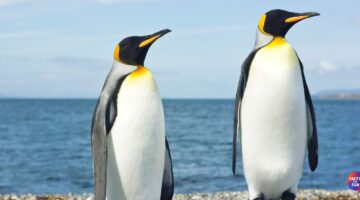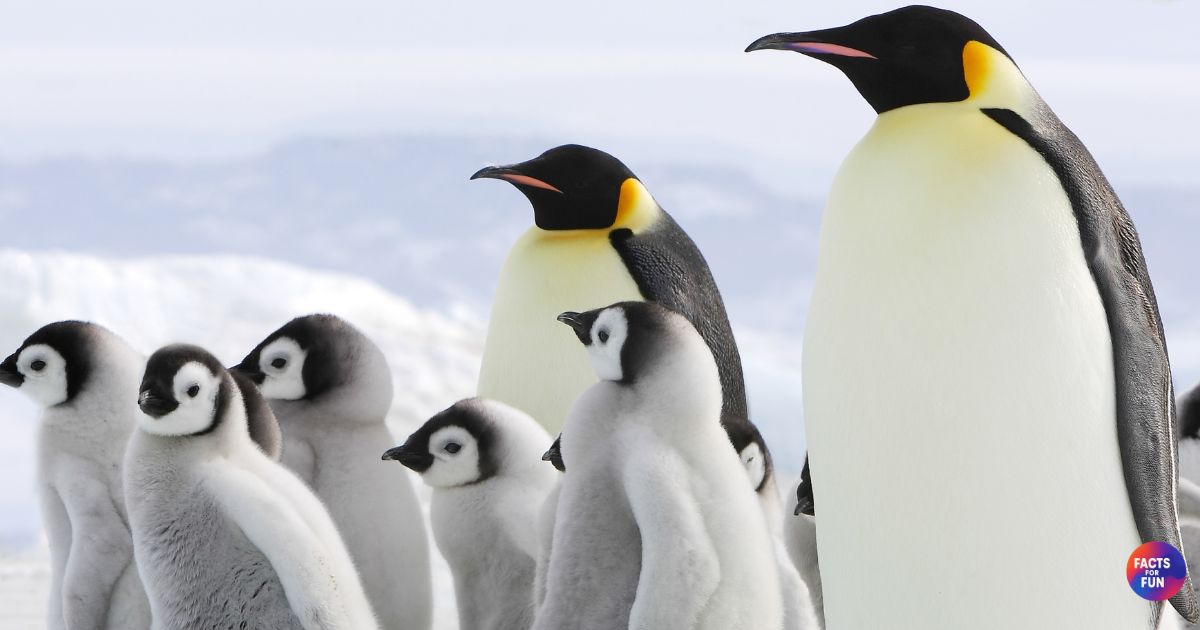
Emperor penguins (Aptenodytes forsteri) are the heavyweight champions of the penguin world and perhaps the most extreme parents among birds. They breed during the Antarctic night, raise chicks on moving sea ice, and dive to depths that crush human submariners without specialized gear. If you’re new to penguins in general, you might also enjoy our broader overview, Fun and Fascinating Facts About Penguin.
Table of Contents:
- The Largest Penguins on Earth
- Antarctica Is Their Only Address
- Winter Is Their Breeding Season
- A March Across Moving Ice
- Sea Ice as a Nursery
- Dense Bones Built for Depth
- The Deepest-Diving Birds
- Masters of Breath-Hold
- Streamlined Like Living Torpedoes
- A Menu of Silverfish, Krill, and Squid
- Parenting on Empty
- The Brood Pouch: Life Against the Cold
- Emergency “Milk,” Rare Among Birds
- Huddling: A Moving Heat Engine
- Feather Armor and Trapped Air
- Counter-Current Heat Exchange
- Tobogganing to Save Energy
- Voiceprints in a Crowd
- Black-and-White Camouflage
- Rapid Molt With Minimal Downtime
- Serial Monogamy, Season by Season
- Colonies Visible From Space
- Climate Change Is the Test They Can’t Outswim
- Giants in the Family Tree
- FAQ
The Largest Penguins on Earth
Adult emperors stand about 4 feet (1.2 m) tall and can weigh from 22 to 45 kg (50–100 lb). That extra mass isn’t just for show: it helps them resist bitter winds on open ice and gives momentum underwater. Heavier bodies also reduce buoyancy, which makes deep diving more efficient. Their scale sets them apart behaviorally too—large size means longer development times for chicks, bigger energy budgets for parents, and an annual cycle tuned to Antarctica’s harshest months.
Antarctica Is Their Only Address
Emperor penguins are endemic to Antarctica, spending their entire life cycle within the Southern Ocean’s pack-ice system. Colonies form where stable “fast ice” hugs the continent, sometimes tens of kilometers from open water. The Antarctic setting dictates everything: when sea ice forms, where colonies can persist, and how far adults must travel to find food. Their survival is a finely balanced negotiation with the ice itself.
Winter Is Their Breeding Season
Unlike other penguins that breed in milder months, emperors court and lay eggs as the sun disappears. Temperatures can plunge below −40 °C, and katabatic winds can exceed 100 mph (160 km/h). Why choose this season? Winter sea ice is usually at its most stable, and chicks that hatch mid-winter can fledge as spring opens feeding opportunities. It’s a high-risk, high-reward schedule that leverages Antarctica’s annual rhythm.
A March Across Moving Ice
Adults commute 50–120 km over rough, shifting sea ice to reach traditional breeding grounds. The route is rarely the same—pressure ridges, cracks, and newly formed leads force constant detours. This journey tests their endurance before reproduction even begins, and it repeats throughout the season as parents shuttle between colony and distant feeding zones.
Sea Ice as a Nursery
Most birds need dry land to nest; emperors raise their young on frozen ocean. Fast ice offers a broad, predator-poor platform—until it doesn’t. If the ice fractures or breaks up early, unfledged chicks may be stranded. The species’ entire breeding strategy depends on ice stability over many months.
Dense Bones Built for Depth
Where typical birds have hollow bones to save weight for flying, emperors have dense, solid bones that resist pressure and reduce buoyancy. This skeletal design lets them descend quickly and remain stable at depth. It also minimizes barotrauma—the tissue stress caused by rapid pressure changes during deep dives.
The Deepest-Diving Birds
Emperors regularly hunt hundreds of meters below the surface, with scientific records approaching ~565 m (1,850+ ft). Pressure at those depths can exceed 50 times what we feel at sea level. Their bodies answer with flexible chest walls, collapsible lungs, and oxygen-rich blood and muscles—an entire physiology retooled for the deep.
Masters of Breath-Hold
A “normal” emperor dive lasts minutes; exceptional dives exceed 20 minutes. They achieve this by slowing their heart rate, routing blood to essential organs, and relying on oxygen stored in myoglobin-packed muscles. Even their swimming patterns—glide phases alternating with powered strokes—are tuned to stretch every molecule of O₂.
Streamlined Like Living Torpedoes
Short, rigid flippers act like hydrofoils, generating lift and thrust with each stroke. The body tapers to reduce drag, while tiny, scale-like feather tips smooth turbulent flow. In bursts, emperors can rocket out of the water in a “porpoising” leap to breathe without slowing down—an elegant solution to a tough energetic problem.
A Menu of Silverfish, Krill, and Squid
Emperors are seafood specialists with a flexible palate. Antarctic silverfish are a staple, but krill and squid fill important seasonal gaps. Parents often range far from colonies to locate productive upwelling zones; a single foraging trip can span days and cover immense distances beneath the ice.
Parenting on Empty
After the female lays a single egg, she heads to sea to rebuild energy reserves. The male becomes a living incubator, fasting for two to four months while balancing the egg on his feet beneath a warm brood pouch. By the time the chick hatches, many fathers have lost up to ~45% of their body mass—an astonishing parental investment rarely matched in the bird world.
The Brood Pouch: Life Against the Cold
The brood pouch is an insulating fold of skin and fat that cradles the egg at near-constant temperature. In the dead of winter, a chick exposed to the air for minutes can chill beyond recovery. The pouch turns a penguin’s belly into a mobile nursery, allowing males to shift position, huddle, and even inch across ice without sacrificing heat.
Emergency “Milk,” Rare Among Birds
If the female’s return is delayed after hatching, the male can secrete a protein- and fat-rich crop “milk” from glands in the upper digestive tract. This stopgap doesn’t replace full feeding but can keep a chick alive for crucial hours or days. Among birds, only a few lineages—pigeons, flamingos, and emperor penguins—show this remarkable adaptation.
Huddling: A Moving Heat Engine
Thousands of emperors gather into tight huddles that can raise local temperatures toward room-like warmth. The huddle is dynamic: individuals rotate from the freezing edge to the toasty center and back, sharing the thermal burden. High-speed imaging shows subtle wave-like shifts rippling across the huddle as birds cooperate to minimize wind exposure and heat loss.
Feather Armor and Trapped Air
Emperors have some of the highest feather densities measured in birds—plus short down and waterproofing oils. Feathers lock in a layer of air that insulates on land and streamlines in water. Even during the annual molt, replacement is rapid so they’re grounded for as few weeks as possible, limiting time without waterproofing.
Counter-Current Heat Exchange
Arteries and veins in flippers and feet run side by side so warm blood leaving the body core shares heat with cold blood returning from extremities. This recaptures energy that would otherwise be lost and helps keep core temperatures steady even when feet stand on ice for hours.
Tobogganing to Save Energy
On ice, waddling is slow and costly. Emperors drop to their bellies and “toboggan,” pushing with feet and flippers to glide over snow. It’s faster, uses less energy, and reduces wind exposure—key benefits when a parent must shuttle between colony and sea repeatedly.
Voiceprints in a Crowd
With no fixed nests and colonies that shift as ice moves, visual cues aren’t reliable. Adults and chicks instead use unique vocal signatures—complex calls that function like fingerprints. A returning parent can navigate a roaring, jostling crowd and still locate its own chick within minutes.
Black-and-White Camouflage
The tuxedo pattern is classic counter-shading: black backs absorb and disguise against the dark depths; white bellies merge with the bright surface when seen from below. The result is stealth both from predators like leopard seals and from prey that might otherwise spot a hunter’s silhouette.
Rapid Molt With Minimal Downtime
Because molting birds can’t swim effectively, emperors compress the replacement of feathers into roughly a month. New feathers erupt before old ones are shed, maintaining coverage and reducing dangerous gaps in insulation or waterproofing. Timing of molt is carefully tuned to the broader breeding and foraging calendar.
Serial Monogamy, Season by Season
Emperors often pair for a single season but reunions across years are uncommon. Synchronizing arrivals on a shifting, ice-dependent schedule is hard; if one partner is late, the other must choose between waiting and risking the egg, or accepting a new mate. Pragmatism, not romance, rules on the ice.
Colonies Visible From Space
Satellite images pick up broad guano stains—dark signatures on bright ice—that reveal colony locations and even rough sizes. This remote sensing tool transformed emperor research by mapping otherwise inaccessible sites and tracking multi-year changes in occupancy.
Climate Change Is the Test They Can’t Outswim
Their entire strategy—winter breeding, fast-ice nurseries, krill-linked food webs—depends on a stable rhythm of freezing and thawing. Warming, shifting winds, and altered sea-ice timing can force longer foraging trips, reduce chick survival, or erase breeding platforms entirely. Projections under high-emissions scenarios show steep declines by 2100 unless ice conditions stabilize.
Giants in the Family Tree
Fossils from New Zealand and Antarctica reveal prehistoric “mega-penguins” that dwarfed modern species. While emperors are the largest living penguins, deep time shows that penguin evolution experimented with even bigger bodies—proof that the lineage has been ocean-bound and innovation-driven since shortly after the dinosaurs vanished.
FAQ
Where do Emperor Penguins live?
Only in Antarctica. They breed on stable sea ice along the coast and forage in the surrounding Southern Ocean. The distance between colonies and open water changes as ice expands and contracts.
How deep can they dive and for how long?
They are the deepest-diving birds, with routine dives of hundreds of meters and verified records near ~565 m. Breath-holds commonly exceed 10–15 minutes, and exceptional dives go past 20 minutes thanks to oxygen-saving physiology.
Why do males fast during incubation?
After the female lays a single egg, she returns to sea to feed. The male incubates in place for ~65–75 days through winter storms, balancing the egg on his feet beneath a brood pouch—an energy-intense job that demands prolonged fasting.
How do they keep warm?
Insulating feathers and blubber, waterproofing oils, counter-current heat exchange in flippers and feet, and cooperative huddling all conserve heat. Behavior and physiology work together to cut losses in brutal wind and cold.
Are they monogamous for life?
Usually monogamous within a season, but low mate fidelity between years. Ice timing and survival pressures make punctual pairing more important than maintaining the same partner.
What do they eat?
Primarily Antarctic silverfish, along with krill and squid. Diet shifts with season, sea-ice conditions, and the distance to productive feeding zones.
Are Emperor Penguins threatened by climate change?
Yes. Their dependence on winter sea ice and krill-based food webs makes them vulnerable to warming and altered ice dynamics. Several models project significant population declines by 2100 under high emissions.
Sources
- Wikipedia – Emperor Penguin
- WWF – Emperor Penguins: Species Facts
- Australian Antarctic Division – Emperor Penguin
- Smithsonian Magazine – Penguin Research Features
- National Geographic Kids – Emperor Penguins
- Audubon – Penguin Facts and Behavior