
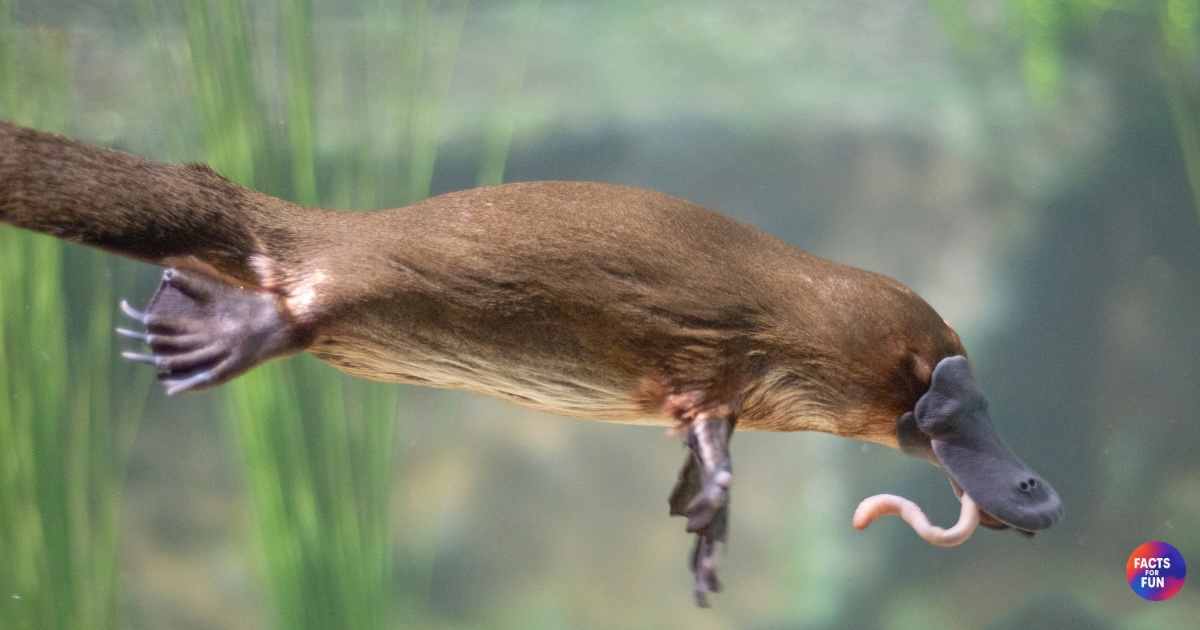
The platypus is one of the most extraordinary animals on the planet – a mammal that lays eggs, glows under UV light, hunts with electric senses, and carries venom on its heels. Scientists once thought this creature was a hoax stitched together in a lab. Today, it remains one of the most fascinating species in evolutionary biology. Below you will find amazing facts about the platypus explained in a simple, engaging way without heavy scientific terms.
- The platypus is one of the only egg laying mammals
- Male platypuses are venomous
- The platypus hunts using electricity
- They glow under ultraviolet light
- They chew food with gravel instead of teeth
- Baby platypuses are called puggles
- Platypus mothers have no nipples
- Fossil evidence shows giant ancient platypuses
- They have one of the strangest sex chromosome systems
- Platypuses store fat in their tails
- They can enter torpor to survive harsh conditions
- Early scientists believed the platypus was a fake
- FAQ
The platypus is one of the only egg laying mammals
The platypus belongs to a tiny and ancient branch of mammalian evolution called monotremes. Instead of giving birth to live young like most mammals, females lay soft shelled eggs and incubate them in carefully built underground nests. This unique combination of reptile like reproduction and mammalian traits makes scientists believe that the platypus preserves some of the oldest features that early mammals once had. Their evolutionary line split off more than 100 million years ago, giving modern biology a rare glimpse into what prehistoric mammals may have looked and behaved like.
Male platypuses are venomous
One of the most unexpected traits of the platypus is the venomous spur on the hind legs of males. The spur is connected to a gland that becomes particularly active during breeding season, suggesting the venom is used for competition rather than hunting. The toxin can paralyze small animals and cause extreme, long lasting pain in humans. What fascinates biologists is that platypus venom contains compounds not found in any other mammal, raising questions about how many different venom systems evolved across the animal kingdom.
The platypus hunts using electricity
While underwater, a platypus shuts its eyes, ears and nostrils completely. Instead, it relies on electroreceptors in its bill to detect the faint electric fields generated by the movement of prey. This sense is so sensitive that a platypus can locate a single wriggling worm buried in mud. It is one of the few mammals capable of using electroreception, a skill most commonly associated with sharks. This remarkable adaptation allows the platypus to hunt effectively even in dark, murky riverbeds.
They glow under ultraviolet light
In 2020 researchers made a surprising discovery: platypus fur fluoresces blue green when illuminated with ultraviolet light. This phenomenon is rare among mammals and has led to several hypotheses. Some scientists believe it might help with camouflage by reducing the animal’s visibility in moonlit environments. Others suggest it could be a remnant of ancient nocturnal ancestors. Although the exact reason remains unknown, the discovery highlights how much about the platypus is still waiting to be understood.
They chew food with gravel instead of teeth
Adult platypuses do not have true teeth, even though their ancestors once did. Instead, they scoop up small stones while collecting prey from the bottom of streams. The mixture of gravel and food is stored in cheek pouches. At the surface, they grind everything between keratin pads, breaking down even tough crustaceans. This unusual technique shows just how creatively evolution can solve physical challenges and how specialized the platypus is for life in fast flowing freshwater systems.
Baby platypuses are called puggles
Young platypuses, known as puggles, hatch from eggs about the size of a large marble. They remain in a soft, warm nesting tunnel for several months, entirely dependent on their mother’s milk. Because the mother has no nipples, puggles lap milk from the surface of her skin. As they grow, they begin developing waterproof fur and eventually learn to swim by following their mother into shallow water. Their early development gives researchers insight into how the first mammals may have raised their young.
Platypus mothers have no nipples
Instead of nursing through nipples, female platypuses release milk through specialized pores on their abdomen. The milk pools on the fur, allowing the young to lap it directly. To compensate for the less sterile feeding surface, platypus milk contains powerful antibacterial proteins. One of these proteins has a unique structure scientists think could inspire new antibiotics in the future, demonstrating how unusual biology can lead to valuable medical discoveries.
Fossil evidence shows giant ancient platypuses
While modern platypuses are about 40–50 cm long, fossil discoveries show that ancient species could reach nearly a meter in length. These prehistoric platypuses had stronger jaws and likely fed on larger animals. The existence of these giants suggests that the platypus lineage once played a much bigger role in ancient ecosystems and may have been more diverse than previously thought.
They have one of the strangest sex chromosome systems
Platypuses possess ten sex chromosomes, arranged in a chain that behaves differently from those of almost all other mammals. Even more surprisingly, some of their chromosome segments resemble those of birds. This unusual mix suggests that platypuses sit at a fascinating evolutionary crossroads and may help scientists understand how sex chromosomes evolved across different branches of vertebrates.
Platypuses store fat in their tails
The wide, flat tail of a platypus serves as a long term energy reserve. When food is abundant, the tail becomes noticeably thicker as fat is stored. During harsher seasons, when prey is scarce and water levels drop, the animal can rely on these reserves for energy. Females also use the tail as a stabilizing support when curling around their eggs during incubation.
They can enter torpor to survive harsh conditions
Platypuses in colder regions of Australia sometimes enter a temporary state of reduced activity called torpor. During torpor, their body temperature and metabolism drop significantly, allowing them to conserve energy for several days. This behavior is not universal across all populations, which suggests that platypuses have evolved region specific survival strategies.
Early scientists believed the platypus was a fake
When British naturalists first examined a preserved platypus specimen in the late 1700s, they suspected a hoax. The idea of an animal with a duck bill, beaver tail and otter like body seemed impossible. Some scientists even looked for stitches. Only after repeated examination did they accept that the animal was authentic, marking one of the most unusual moments in zoological history.
FAQ
Why are platypuses considered unique mammals?
Platypuses stand apart from almost every other mammal because they blend characteristics that usually never appear together in one animal. They lay eggs like reptiles, yet produce milk like mammals. They have electroreception in their bill, a sense usually found in sharks. Males produce venom, which is extremely rare among mammals. Their sex chromosomes resemble both mammal and bird systems, suggesting a very ancient evolutionary lineage. All of this makes the platypus one of the most unusual and scientifically valuable species for understanding how mammals evolved.
Are platypuses dangerous to humans?
Platypuses are shy and avoid conflict, but males do have venomous spurs on their hind legs. The venom is not deadly to humans, yet it can cause intense swelling and severe pain that regular painkillers often cannot relieve. In some cases, increased sensitivity in the affected area can last for months. The venom is believed to be used primarily in territorial disputes during breeding season rather than for hunting or defense against predators, meaning humans are almost never at risk unless they attempt to handle a wild platypus.
What do platypuses eat?
Platypuses are expert hunters that forage underwater, relying on electroreception instead of sight. Their diet includes insect larvae, worms, freshwater shrimp, snails and small crustaceans. They scoop prey from the riverbed and store it in cheek pouches, along with bits of gravel. Since adult platypuses don’t have teeth, the gravel acts as a grinding tool. Once the animal surfaces, the mixture of food and stones is mashed using keratin pads inside the bill. This unique method allows them to process tough prey without needing true teeth.
Can you keep a platypus as a pet?
No. Platypuses cannot be kept as pets under any circumstances. They are legally protected in Australia, and their complex needs make care impossible in a home environment. They require cold, clean, flowing freshwater, abundant live prey, and large burrow networks. Even professional zoos outside Australia have never successfully kept platypuses long term because of these strict requirements. Their specialized biology and environmental sensitivity mean they must remain in the wild or in the care of Australian wildlife experts.
Why do platypuses glow under UV light?
Scientists discovered in 2020 that platypus fur fluoresces blue green under ultraviolet light. The exact purpose of this glow remains a mystery. Some researchers suggest it could help reduce visibility to predators or prey by absorbing UV light in moonlit environments. Others propose that it may be a leftover trait from early mammalian ancestors, many of which were nocturnal. While the function is still debated, the discovery adds yet another layer to the platypus’s already complex and fascinating biology.
What habitat do platypuses need to survive?
Platypuses rely on clean, freshwater ecosystems such as rivers, creeks and billabongs with stable banks for burrow building. They need slow to moderate water flow, abundant insect larvae and sheltered areas for nesting tunnels. Even small changes in water quality, such as pollution, sediment buildup or reduced flow, can sharply reduce their ability to find food. This sensitivity is one reason conservationists closely monitor river health in eastern Australia.
How do platypuses swim so efficiently?
Platypuses use their front limbs for powerful paddling while their back legs act mainly as rudders to steer. Their webbed feet create wide “blades” in the water, increasing surface area for propulsion. When the platypus walks on land, the webbing retracts, allowing the animal to use sharp claws for grip. This dual purpose design makes them surprisingly agile both in water and around muddy riverbanks.
How long do platypuses live in the wild?
Most platypuses live between 10 and 12 years in the wild, though some individuals have reached over 20 years in protected environments. Their lifespan depends heavily on the quality of their habitat. Areas with stable water levels, fewer predators and low human disturbance tend to support longer lived populations.
What threats do platypuses face today?
Platypuses are impacted by habitat loss, drought, climate change, riverbank erosion and water pollution. Bushfires can destroy entire watersheds, removing shade, altering temperatures and reducing prey populations. In some regions, introduced predators like foxes can dig up burrows. Human activities such as dam construction and land clearing also fragment rivers, making it harder for platypuses to move between feeding areas.
How do scientists study platypuses in the wild?
Because platypuses are shy, nocturnal and excellent swimmers, researchers use special techniques to study them. These include underwater cameras, environmental DNA sampling, radio transmitters and thermal imaging near riverbanks. Scientists also examine abandoned burrows and monitor electric activity in streams to estimate population sizes. Studying platypuses is challenging, but these methods help avoid disturbing the animals while providing valuable ecological data.
Sources
Wikipedia – Platypus
National Geographic Kids – Duck Billed Platypus
Australian Museum – Platypus
WWF Australia – 10 Fascinating Platypus Facts
WILD LIFE Sydney Zoo – Platypus Facts
Watch Our Platypus Hunting Video
Want to see how a platypus can hunt with its eyes, ears and nose completely closed? In this short video, you’ll discover how this remarkable mammal uses electric signals in the water to track down hidden prey. It’s a quick 40-second clip that shows the platypus’s “sixth sense” in action with clear, fascinating visuals. Watch here: