
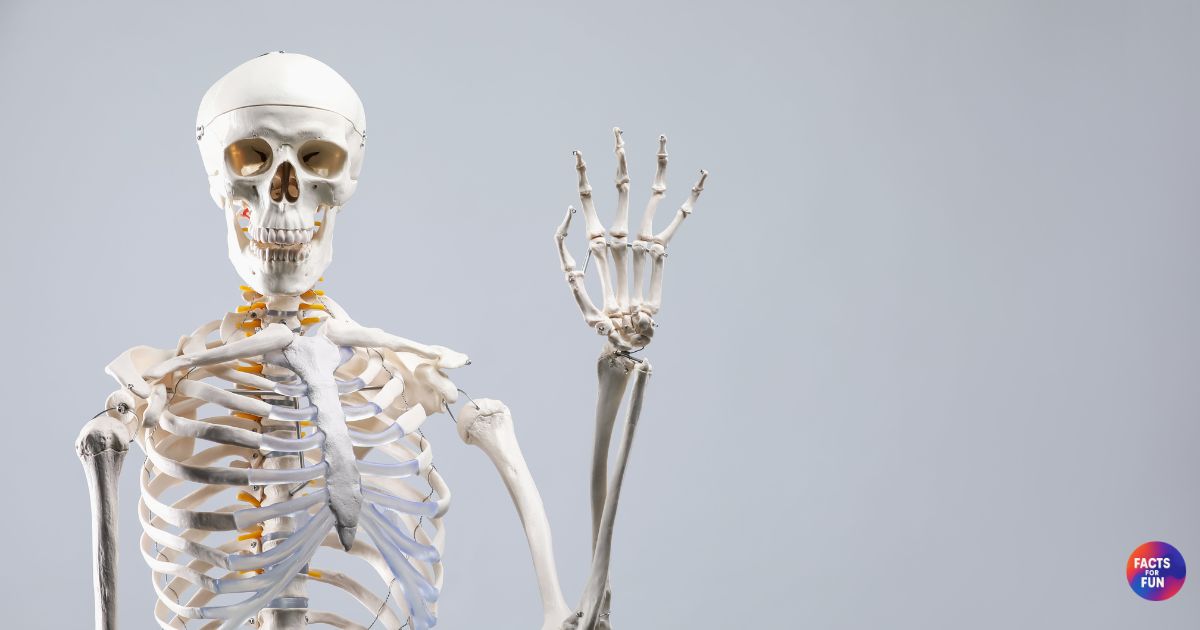
Our skeleton is far more than a rigid frame — it’s a living, adaptable, and surprisingly dynamic system. Every bone, from your skull to your toes, plays a part in movement, protection, and even hormone production. Let’s uncover some of the most surprising facts about the human skeleton.
Table of Contents:
- Babies are born with more bones than adults
- The smallest bone lives inside your ear
- The femur is a powerhouse of strength
- More than half your bones are in your hands and feet
- There’s one bone that doesn’t touch any other
- Your skeleton renews itself every few years
- Bones produce stress and energy hormones
- Bone is stronger than steel, yet much lighter
- Tooth enamel is tougher than bone
- The female pelvis is built for childbirth
- Humans get taller in space
- Bone healing time depends on size
- Babies don’t have real kneecaps
- Bones shield vital organs
- The “funny bone” isn’t actually a bone
- Bone marrow creates life itself
- Four types of bones shape our body
- Lifestyle changed our bones through evolution
- Some people are born with an extra rib
- Broken bones date back to ancient humans
- FAQ
Babies are born with more bones than adults
At birth, a human baby has about 300 bones. As we grow, many of these fuse together, forming stronger, larger structures. By adulthood, we have 206 bones. This fusion helps stabilize joints, support weight, and protect internal organs.
The smallest bone lives inside your ear
Deep within the middle ear lies the stapes, or “stirrup,” the tiniest bone in the human body. It’s only 3 millimeters long and transmits sound vibrations from the eardrum to the inner ear. Without it, our sense of hearing would lose its precision and volume.
The femur is a powerhouse of strength
The femur, or thigh bone, is not only the longest bone in your body — it’s also the strongest. It can withstand forces up to 30 times your body weight. Its length and density make it vital for standing, walking, and absorbing impact during movement.
More than half your bones are in your hands and feet
Out of 206 bones in the body, over 100 are found in the hands and feet alone. Each hand has 27 bones, and each foot has 26. This incredible design gives humans both strength and precision — allowing us to grasp, balance, and move gracefully.
There’s one bone that doesn’t touch any other
The hyoid bone, located in the throat, is the only “free-floating” bone in the body. It doesn’t connect to any other bone but is suspended by muscles and ligaments. It plays an essential role in speech and swallowing — a key feature that separates humans from most animals.
Your skeleton renews itself every few years
Bones may seem hard and static, but they’re alive and constantly remodeling. Specialized cells called osteoclasts break down old bone tissue, while osteoblasts build new layers. Over roughly seven years, your entire skeleton is replaced — a complete biological renovation.
Bones produce stress and energy hormones
Beyond structure, bones are secretory organs. They release osteocalcin — a hormone that helps regulate blood sugar, fat storage, and even the body’s response to stress. This discovery reshaped our understanding of how bones influence metabolism and mood.
Bone is stronger than steel, yet much lighter
Pound for pound, bone is about four times stronger than concrete and as strong as steel — but 50 times lighter. Its lattice-like structure gives it incredible strength and flexibility. This balance of rigidity and lightness allows humans to move efficiently without breaking under pressure.
Learn more about this surprising property in our article Facts About Bones Stronger Than Steel.
Tooth enamel is tougher than bone
Though not technically a bone, enamel — the outer coating of teeth — is the hardest substance in the human body. It’s made mostly of minerals and lacks collagen, making it even more resistant to wear than your femur. Once lost, however, enamel doesn’t regenerate.
The female pelvis is built for childbirth
The female pelvis is wider and more flexible than the male’s, designed to accommodate pregnancy and delivery. During childbirth, ligaments loosen and pelvic joints shift slightly to create space — a natural adaptation for one of life’s most important processes.
Humans get taller in space
In zero gravity, the spine lengthens because the discs between vertebrae expand without compression. Astronauts can become about 3 % taller in space, though the effect reverses when gravity returns on Earth.
Bone healing time depends on size
Bones heal themselves remarkably well, but recovery speed varies. Smaller bones like fingers or toes may mend in 6–8 weeks, while major bones such as the femur can take up to 6 months. The process requires a precise balance of calcium, collagen, and blood supply.
Babies don’t have real kneecaps
Infants are born with soft cartilage in their knees instead of hard bone. Over time, this cartilage ossifies, forming solid kneecaps around age 10–12. This flexibility protects babies as they learn to crawl and walk.
Bones shield vital organs
One of the skeleton’s most important jobs is protection. The skull guards the brain, the rib cage shelters the heart and lungs, and the spine protects the spinal cord. These structures evolved to preserve life’s most delicate systems.
The “funny bone” isn’t actually a bone
When you hit your elbow and feel a sharp tingling, that’s not a bone at all — it’s your ulnar nerve. It runs along the humerus (upper arm bone), which is why it’s called the “funny bone.” The sensation is a brief nerve shock, not humor at work.
Bone marrow creates life itself
Inside large bones like the pelvis and femur is bone marrow — the body’s blood factory. It produces red blood cells for oxygen transport, white cells for immunity, and platelets for clotting. Without it, survival would be impossible.
Four types of bones shape our body
Bones are categorized by shape: long (arms and legs), short (wrists and ankles), flat (ribs and skull), and irregular (vertebrae). Each type serves a unique function, from leverage and protection to flexibility and structure.
Lifestyle changed our bones through evolution
When early humans shifted from hunting to farming, their bone density decreased. Sedentary life reduced the mechanical stress on bones, leading to lighter skeletons. This adaptation reflects how lifestyle can physically reshape the body over generations.
Some people are born with an extra rib
While most people have 12 pairs of ribs, about 1 % of humans are born with a 13th pair — called cervical ribs. They usually cause no harm but can sometimes compress nearby nerves or arteries, requiring surgical removal.
Broken bones date back to ancient humans
Archaeological finds show that Neanderthals and early Homo species suffered fractures and bone spurs. A 120,000-year-old fossil revealed bone growths identical to modern conditions, proving that orthopedic problems are as old as humanity itself.
FAQ
How many bones does a human have?
An adult has 206 bones. Babies start with about 300, but many fuse together as they grow. This natural fusion strengthens the skeleton and allows for better support and movement.
Which bone is the strongest?
The femur, or thigh bone, is the largest and strongest in the human body. It supports nearly all your weight when standing or walking and can withstand up to 1,800 kilograms of force.
How often do bones regenerate?
Bone tissue completely renews itself roughly every seven years. Tiny micro-fractures constantly appear and are repaired by specialized cells, keeping your skeleton healthy and strong.
Are bones alive?
Yes — bones are living tissue. They contain cells, blood vessels, and nerves. Bone cells constantly rebuild the matrix, respond to hormones, and help regulate minerals like calcium and phosphorus.
What causes bones to weaken with age?
With aging, bone density decreases as production of new tissue slows. Calcium and vitamin D deficiency, inactivity, and hormonal changes accelerate bone loss, leading to osteoporosis.
Do men and women have the same bones?
Both sexes have 206 bones, but their shape and size can differ. For example, female pelvises are broader, and male skulls have more pronounced ridges. These differences reflect functional adaptations rather than quantity.
Can bones tell scientists about ancient humans?
Absolutely. Fossilized bones reveal age, diet, disease, and even lifestyle. Patterns of wear and healed fractures tell stories about how early humans lived, worked, and evolved.
Is it true that astronauts lose bone mass in space?
Yes. In microgravity, bones lose density because they aren’t bearing weight. Astronauts can lose up to 1 % of bone mass per month in space, so exercise and nutrition are vital to counteract this effect.
Sources
- Wikipedia – Human Skeleton
- Better Health Channel – Bones
- kdms Hospital – 14 Bone Facts You Might Not Know
- BIDMC of Boston – Fun Facts About Bones and Joints
- Winston Medical Center – Human Bones and Muscles Facts