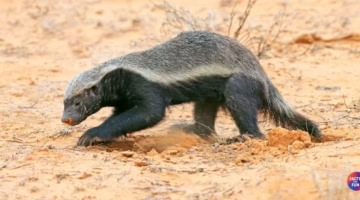
If you’ve already read our Fascinating Facts About the Honey Badger — Nature’s Toughest Animal, you know this fearless creature is one of nature’s greatest survivors. But what exactly makes the honey badger (Mellivora capensis) so indestructible? The secret lies in its anatomy — a compact yet formidable structure built to endure bites, venom, and brutal fights. From its armor-like skin and crushing jaws to its hidden ears and chemical defenses, every part of the honey badger’s body is fine-tuned for survival.
Table of Contents:
A Compact Body Built for Battle
Honey badgers have short, sturdy bodies with wide backs and powerful shoulders. Their design prioritizes endurance and strength over speed, giving them the advantage in fights and digging. The phrase “built like a tank” fits perfectly — they can dig through hard soil, chase prey into burrows, or take on predators much larger than themselves.
Armor-Like Skin
Their skin can reach up to 6 millimeters thick — denser than the hide of a buffalo. This flexible armor protects them from bee stings, snake bites, and porcupine quills. Even when a predator grabs them, the loose skin allows the badger to twist inside it and bite back.
The Secret of Elastic Defense
Honey badgers owe much of their survival to their unusually loose and stretchy skin. This elasticity acts like a natural escape mechanism: even if caught by the neck, they can spin around and counterattack. Combined with dense muscles and short, strong limbs, they can resist being pinned or torn apart.
Hidden Ears and Powerful Senses
Honey badgers have no visible ears. Instead, their ear openings are hidden under thick folds of skin — protection during fights or when digging. Despite this, they possess sharp hearing, excellent night vision, and a strong sense of smell that helps them find prey buried underground.
Jaws Strong Enough to Crush Bone
Their jaw structure is one of the strongest among small carnivores. The joints are reinforced to prevent dislocation, and their molars can crack turtle shells or grind through bones. They even consume entire carcasses, including fur and feathers — nothing goes to waste.
Deadly Claws for Digging and Hunting
Honey badgers have long, curved claws on their front paws that can reach 4 centimeters in length. These claws are designed for tearing through soil, termite mounds, and even thick bark. A single badger can dig a tunnel up to 10 feet long in just ten minutes.
Built to Survive Venom
One of the honey badger’s most astonishing features is its tolerance to venom. Thanks to molecular adaptations in their nerve receptors, they can withstand bites from deadly snakes like cobras and puff adders. Some even fall into a brief coma after a bite, only to wake up hours later and continue eating the snake.
Their “Chemical Weapon”
Honey badgers possess scent glands beneath their tails that release a suffocating, skunk-like odor. They use it to mark territory or ward off enemies. Many predators — even lions — have been observed retreating after being sprayed.
Color Pattern of Warning
Their black underbody and gray-white back stripe form a striking “don’t mess with me” pattern. This bold contrast is thought to serve as a warning to potential predators. Interestingly, young cheetah cubs mimic this coloration in their early months, gaining protection through imitation.
Anatomy Designed for Survival
Everything about the honey badger’s anatomy — its thick bones, muscular build, and sharp claws — reflects its status as one of nature’s toughest animals. Combined with intelligence and adaptability, these physical traits make it a near-perfect survivor in the wild. To explore how honey badgers think and solve problems, read our article Facts About Honey Badger Behavior and Intelligence.
FAQ
Why is the honey badger’s skin so thick and loose?
Its skin is both armor and a defense mechanism. The thickness protects it from bites and stings, while the looseness allows it to twist inside its skin and counterattack when caught.
How do honey badgers survive snake bites?
They’ve evolved a molecular resistance to venom. Neurotoxins from snakes like cobras don’t bind as effectively to their receptors, letting them survive what would kill most animals.
Why don’t honey badgers have visible ears?
Their ears are hidden beneath skin folds to prevent injuries during fights or while digging. Despite that, their hearing is excellent.
What are honey badger scent glands used for?
They release a powerful odor to mark territory or deter attackers. The smell is so unpleasant that even lions often back away.
Are honey badgers related to regular badgers?
Not directly. Though they share a similar appearance, honey badgers are more closely related to wolverines than to European badgers.
Sources