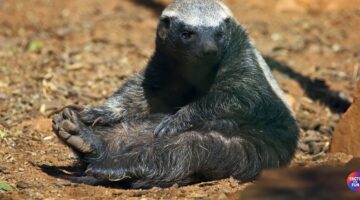
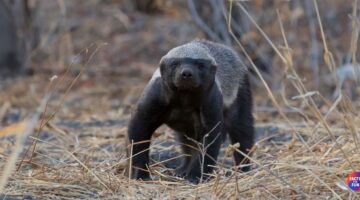
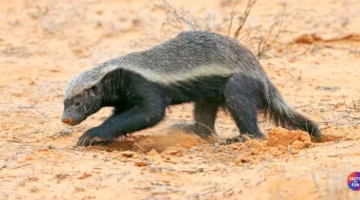
At first glance, cheetah cubs look nothing like the sleek, spotted sprinters they will become as adults. Instead, young cubs have long, shaggy gray fur and dark undersides that closely resemble the appearance of honey badgers. This unusual resemblance has fascinated scientists for decades and raised an important question: why would one of the fastest animals on Earth begin life looking like one of the most aggressive mammals instead?
- Cheetah cubs are born with a distinctive mantle
- Honey badgers have a reputation predators avoid
- Mimicry is rare but powerful among mammals
- How resemblance may protect cheetah cubs
- Scientific debate and alternative explanations
- When and why the resemblance disappears
- What this tells us about evolution
- FAQ
- Sources
Cheetah cubs are born with a distinctive mantle
Cheetah cubs are born with a thick, upright mantle of grayish fur that runs along their back from head to tail. This coat gives them a stocky silhouette and muted coloration very different from adult cheetahs. The mantle is most prominent during the first three months of life and gradually fades as the cub grows. By the time a cheetah reaches six months of age, the shaggy fur has largely disappeared, revealing the familiar spotted coat adapted for speed and camouflage.
This early-life appearance is not accidental. It coincides with the period when cheetah cubs are most vulnerable to predators and lack the speed that defines adult cheetahs.
Honey badgers have a reputation predators avoid
Honey badgers are widely known for their fearless behavior, thick skin, and aggressive defense strategies. Many predators learn to avoid them because attacks often result in injury rather than an easy meal. This reputation extends beyond direct encounters and influences predator behavior through visual recognition.
On the African savanna, predators such as lions, leopards, and hyenas are selective hunters. Targeting prey that fights back aggressively can be costly. The honey badger’s bold coloration and stocky outline are associated with danger rather than vulnerability. For a broader explanation of why predators avoid honey badgers, see our main guide on honey badger anatomy, behavior, and survival strategies.
Mimicry is rare but powerful among mammals
Mimicry is common in insects, reptiles, and amphibians, but it is relatively rare in mammals. When it does occur, it usually involves subtle visual cues rather than exact imitation. Mammalian mimicry tends to appear during vulnerable life stages, especially in juveniles that cannot yet rely on speed, size, or strength for protection.
In the case of cheetah cubs, their mantle, coloration, and posture resemble those of a honey badger at a distance. This resemblance may function as a form of defensive mimicry, where predators hesitate long enough for the cub to avoid detection or for its mother to intervene.
How resemblance may protect cheetah cubs
Cheetah cub mortality rates are among the highest of any large African carnivore. In some regions, fewer than half of all cubs survive to adulthood. Lions, leopards, and hyenas are the primary threats. Any adaptation that slightly reduces detection or discourages attack can significantly improve survival odds.
The honey badger-like appearance of cheetah cubs may cause predators to misidentify them, especially in tall grass or low-visibility conditions. Even a brief hesitation can be enough to prevent an attack. This does not mean predators believe the cub is a honey badger in a literal sense, but rather that the visual cues trigger caution rather than pursuit.
Scientific debate and alternative explanations
Not all scientists agree that cheetah cubs intentionally mimic honey badgers. Some researchers suggest that the mantle primarily serves as camouflage, breaking up the cub’s outline in grasslands. Others propose that the thick fur provides insulation or protection from sun exposure during early development.
However, these explanations do not fully account for the striking resemblance in color and silhouette to honey badgers, especially given the honey badger’s well-known reputation among predators. Most modern interpretations suggest that the resemblance likely provides multiple benefits, combining camouflage, predator deterrence, and thermal regulation rather than serving a single purpose.
When and why the resemblance disappears
As cheetah cubs grow, their survival strategy changes. Once they gain speed and agility, reliance on visual deterrence becomes less important. The shaggy mantle gradually disappears, and the cub develops the lean, aerodynamic body optimized for sprinting.
This transition reflects a broader evolutionary pattern: early-life defenses prioritize concealment and deterrence, while adult defenses rely on performance and skill. In cheetahs, that skill is unmatched speed.
What this tells us about evolution
The resemblance between cheetah cubs and honey badgers highlights how evolution can favor indirect solutions to survival. Instead of fighting or fleeing, young cheetahs benefit from borrowing the reputation of a more aggressive species during their most vulnerable stage of life.
This strategy shows how natural selection often works by reducing risk rather than eliminating it. Even small advantages during early development can shape the survival of an entire species.
FAQ
Do cheetah cubs really imitate honey badgers?
Cheetah cubs do not consciously imitate honey badgers, but their appearance closely resembles honey badgers during early life. This resemblance may discourage predators from attacking, providing a survival advantage.
How long do cheetah cubs look like honey badgers?
The resemblance is strongest during the first three to four months of life. By six months, the shaggy mantle fades and the cub’s coat begins to resemble that of an adult cheetah.
Is this type of mimicry common in mammals?
No. Mimicry is relatively rare among mammals, making the cheetah-honey badger resemblance a particularly interesting example of evolutionary adaptation.
Do predators really avoid honey badgers?
Many predators avoid honey badgers because they are aggressive, difficult to kill, and capable of causing injury. This reputation likely influences predator decision-making even without direct encounters.
Are there other animals that use similar strategies?
Yes, but they are uncommon. Some mammals and birds show juvenile traits that reduce predation risk, but clear visual mimicry like this is rare.
Sources
This article is based on peer-reviewed research and reputable educational sources.
- National Geographic – Cheetah Cubs and Survival Strategies
- Smithsonian National Zoo – Cheetah Development and Behavior
- Caro, T. (1994). Cheetahs of the Serengeti Plains. University of Chicago Press
- Begg, C. & Begg, K. (2013). The Secret Life of the Honey Badger
- Animal Diversity Web – Acinonyx jubatus